Lanna country
Lanna was its own kingdom for six hundred years before it was ever part of Thailand, and the north still knows it. Different script, different food, different temples — and a lot of them still working buildings rather than exhibits.
Doi Inthanon is the highest point in Thailand at 2,565 metres, and it is cold at the top — genuinely cold, often ten degrees below the city.
The twin pagodas sit below the summit: Naphamethanidon built for the King's sixtieth birthday and Naphaphonphumisiri for the Queen's, one in weathered stone and one in deep purple-brown, each with a staircase and terraced gardens looking out over the range.
On a clear morning the view runs to the horizon in folds of blue. On a misty one you cannot see the second pagoda from the first, which is arguably better.
Wat Phra That Doi Suthep is the one on every postcard and it earns it. Gold chedi, 306 steps flanked by naga serpents, and a terrace looking straight down over Chiang Mai.
It is a functioning temple with monks living in it, so there is a dress code — shoulders and knees covered — and it is worth arriving early before the coaches.
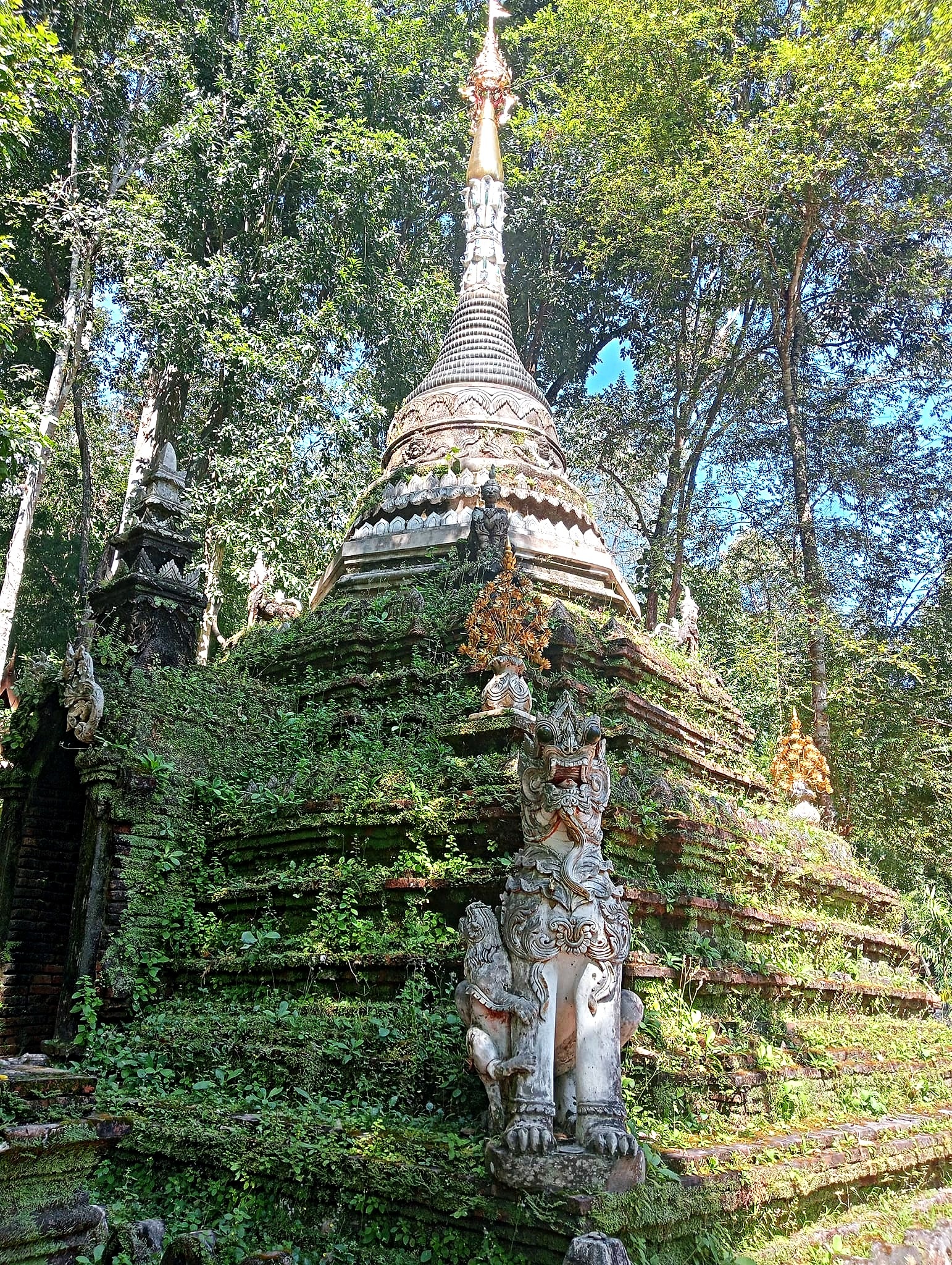
Not everything in the north is maintained. There are chedis in the forest with roots through the brickwork and moss over the singha guardians, still with offerings at the base because people still come.
These are the ones worth the detour. No ticket office, no crowd, and a sense of age that a restored temple cannot give you.
The hills around Chiang Mai are home to several distinct peoples — Karen, Hmong, Lisu, Akha — with their own languages, textiles and farming.